Welcome: Hebei Hangcheng Hoisting Machinery manufacturing Co. Ltd


info@hangchenghoist.com
+86 13932282895

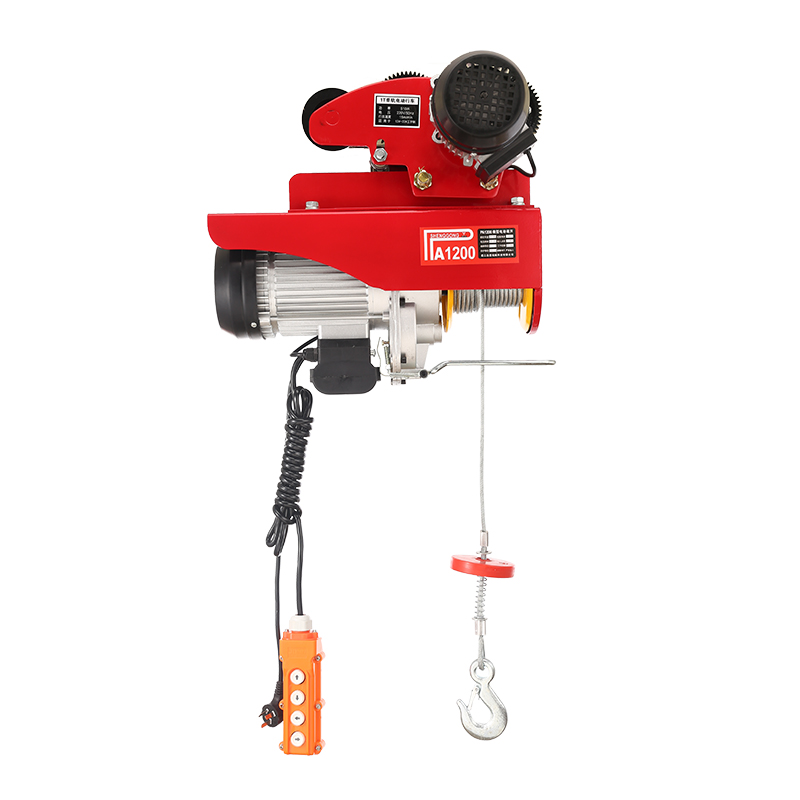
An electric hoist with trolley combines two functions in one system: the hoist provides vertical lifting, while the trolley enables horizontal travel along an I-beam or runway. This setup is widely used in workshops, warehouses, production lines, and maintenance areas where loads must be lifted and positioned quickly with less manual handling.
Compared with a fixed (stationary) hoist, adding a trolley reduces time spent repositioning the lifting point and helps streamline repetitive lifting tasks.
An electric hoist with trolley consists of two coordinated mechanisms:
Hoisting unit: motor + gearbox + wire rope (or chain) lifts the load up/down.
Trolley unit: manual or electric drive moves the hoist left/right along the beam.
Operators can control lifting and travel independently or together, which allows loads to be lifted, moved, and positioned precisely without additional equipment. Electrically driven trolleys typically offer smoother acceleration and braking to help reduce load swing and improve control.
A practical trolley-hoist system is compact but robust. Core parts include: hoist motor, wire rope, trolley frame, travel drive, braking system, and pendant control.
From a buyer’s perspective, the details that most affect performance are:
Motor quality (stable torque, reliable heat dissipation)
Braking performance (secure stopping and load holding)
Wheel and bearing design (smooth travel, reduced wobble)
Control safety (emergency stop, limit protection)
Choose a trolley hoist system when your work requires both lifting and positioning along a fixed path:
Lift motors, gearboxes, tools, and components—and travel them directly to the workbench or service area.
Move crates, equipment, and heavy packages along a beam line where forklifts are inconvenient or space is limited.
Position parts across multiple stations with consistent speed and less operator effort.
Deliver materials to the required point along a beam with better control and reduced manual carrying.
Electric trolley travel is ideal for frequent movement, longer travel distance, and heavier loads. A manual trolley is often suitable for occasional movement where simplicity and cost are priorities.
Rule of thumb
Frequent lifting + frequent traveling → Electric trolley
Low frequency traveling → Manual trolley
Need higher control and reduced swing → Electric trolley with braking
Before choosing a model, confirm these basics:
Rated capacity: select above your maximum working load.
Beam size/type: ensure trolley matches your I-beam range.
Travel length: how far you need to move along the beam.
Duty cycle: how often it runs per shift.
Environment: dust, humidity, temperature extremes may require extra protection.
Proper selection improves safety and extends service life.
Electric hoists with trolleys typically include overload protection, limit switches, and braking systems, and they require routine inspection of wire rope/chain, brakes, and electrical components.
A simple maintenance schedule—inspection, lubrication, fastener checks, and control responsiveness—reduces downtime and improves consistency.
If you share your load capacity, lifting height, beam size, and voltage, we can recommend suitable configurations and provide OEM options (branding, packaging, wire rope length, voltage).
Name: Zoe Liu
Mobile:+86 13932282895
Tel:+86 13932282895
Whatsapp:8613932282895
Email:info@hangchenghoist.com
Add:Southwest of Weigezhuang Village, Donglu Township, Qingyuan District, Baoding City, Hebei Province, China